
Filtration system for removing iron and manganese from well water CWG-FILT/ PY 20-0 for the process industry
27.02.2026.
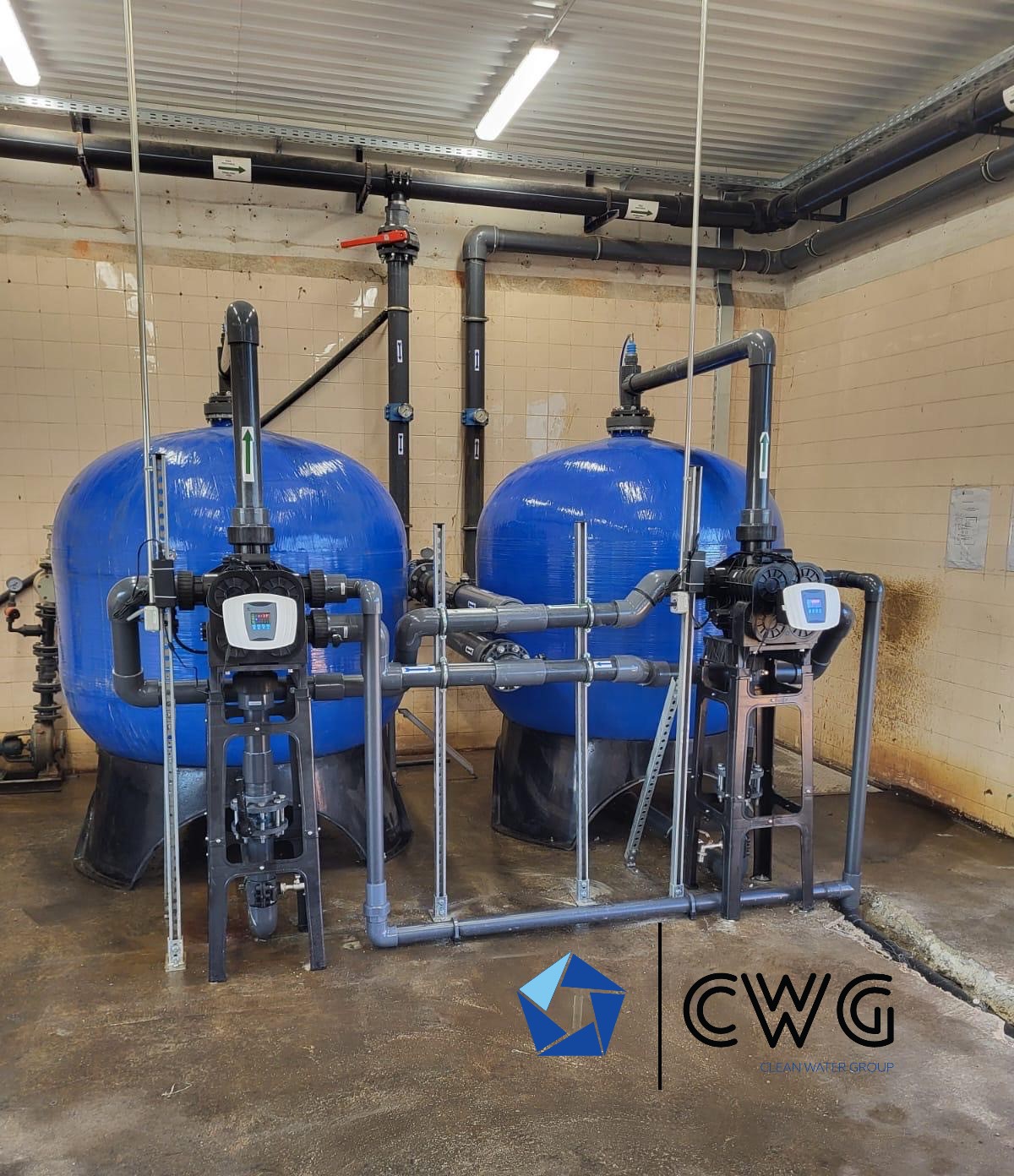
At the beginning of 2026, we will start with a new installation of a system for removing iron and manganese from well water for the supply needs of the process industry. The device model CWG-FILT / PY 20-0 with a processing capacity of 20,000 liters/hour of well water ensures reliable and high-quality treatment for its users.
Iron and rust in water: why does water turn yellow, what destroys it and how to permanently clear it
Pour a glass of water and it’s clear. Let it sit or heat it up — and it turns yellow, brown, or leaves a rusty residue. Your plumbing has reddish-orange stains, your laundry has gray rust tones, and your water tastes metallic. If this is happening, you almost certainly have iron in your water , and the problem is most common among those who use their own source — a well or borehole . In this guide, we explain why this happens, how to recognize what kind of iron it is, and which technology really solves the problem.
Where does iron come from and why is the water first clear and then brown?
Iron (Fe) is one of the most abundant elements in the Earth’s crust, so it is not surprising that water picks it up as it passes through rocks and soil. It can enter water in two ways: naturally , by dissolving from geological layers (typically in groundwater), and by corrosion of old steel or galvanized pipes, which release rust over time.
The key to understanding the problem is oxygen chemistry. In deep groundwater, where there is no oxygen, iron is in a dissolved, divalent form (Fe²⁺) — it’s invisible, so tap water is clear. As soon as that water comes into contact with oxygen from the air (through aeration, in a pressure vessel, at the tap), the iron oxidizes to the trivalent form (Fe³⁺) , which is insoluble and creates the distinctive rusty, brown flakes and precipitate . That’s why water “darkens after standing” — you’re watching oxidation in real time.
It is useful to distinguish:
- “Clear” iron (clear-water iron): the water is clear at the outlet, and only after some time or heating does it form a sediment. Typical for groundwater.
- “Red” iron (red-water iron): the water is already colored at the tap because the iron has already oxidized (e.g. from rusty pipes).
Very important: where there is iron, there is almost always manganese , so these two problems are treated together, with one correctly chosen system.
How to identify iron in water
- The water is clear at the spout, but turns brown/yellow after standing or heating.
- Reddish-brown, rusty stains on sinks, toilets, bathtubs, tiles, and laundry — they are difficult to remove.
- Metallic taste in water (many people notice it from as low as approximately 0.3 mg/L).
- Brown sediment and deposits in pipes, water heater, stove and household appliances.
- Clogging of filters, nozzles, aerators and valves with rusty sludge.
- Sometimes there are slimy, gelatinous deposits — a sign of iron bacteria that feed on iron.
Limit values (EU)
According to the EU Drinking Water Directive (2020/2184) and its implementation in the national legislation of the Member States, iron is an indicator parameter with a limit value of 200 µg/L, or 0.2 mg/L . This is not a “toxic” limit but a threshold above which the water becomes discoloured, has a bad taste and is technologically problematic. Many wells exceed this value by several times, sometimes by several mg/L.
Our solutions for the treatment of well water are a safe and reliable solution, proven in more than 100 locations.
Learn more at: IRON AND MANGANESE REMOVAL SYSTEMS
