Softening

Water softening is the process of removing ionic minerals, especially calcium and magnesium, from water to reduce water hardness.

The hardness of water comes from the presence of dissolved calcium and magnesium salts in water, often carbonates and sulfates. Although these minerals are not harmful to health, they can cause unwanted problems in households and industry. Water softening is often carried out by applying ionic exchange to reduce the concentration of these minerals.

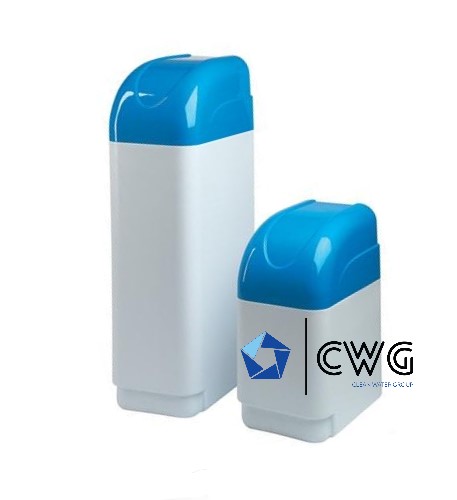
The ion exchange process is often used to soften water. This procedure involves replacing calcium and magnesium with ion ions, usually sodium. A key element in the ion exchange process is a water softener, known as a softener.

The water softener contains a resin that is full of sodium ions. When hard water passes through the resin, calcium and magnesium ions are adsorbed to the resin, while sodium ions are released into the water. This process means that the water coming out of the softener contains less calcium and magnesium, reducing the hardness of the water.

When the resin becomes saturated with calcium and magnesium ions, it needs to be regenerated. This is achieved by passing a concentrated salt solution (sodium chloride) through the resin. Salt replaces the adsorbed calcium and magnesium ions on the resin, which is washed off and re-prepared to soften a new amount of water.

Ion exchange allows for efficient and continuous softening of water, ensuring that water hardness remains low and that water is suitable for household and industrial needs.

For more information or a direct offer, please contact us:
Contact form
Or by email: [email protected]

Ionic exchange of water softening is a process that requires precise adjustment to ensure optimal efficiency and minimal salt loss. Water softeners often have automatic controls that monitor water consumption and regulate the regeneration process. This ensures that the fabric softener is always ready to soften the new amount of water.

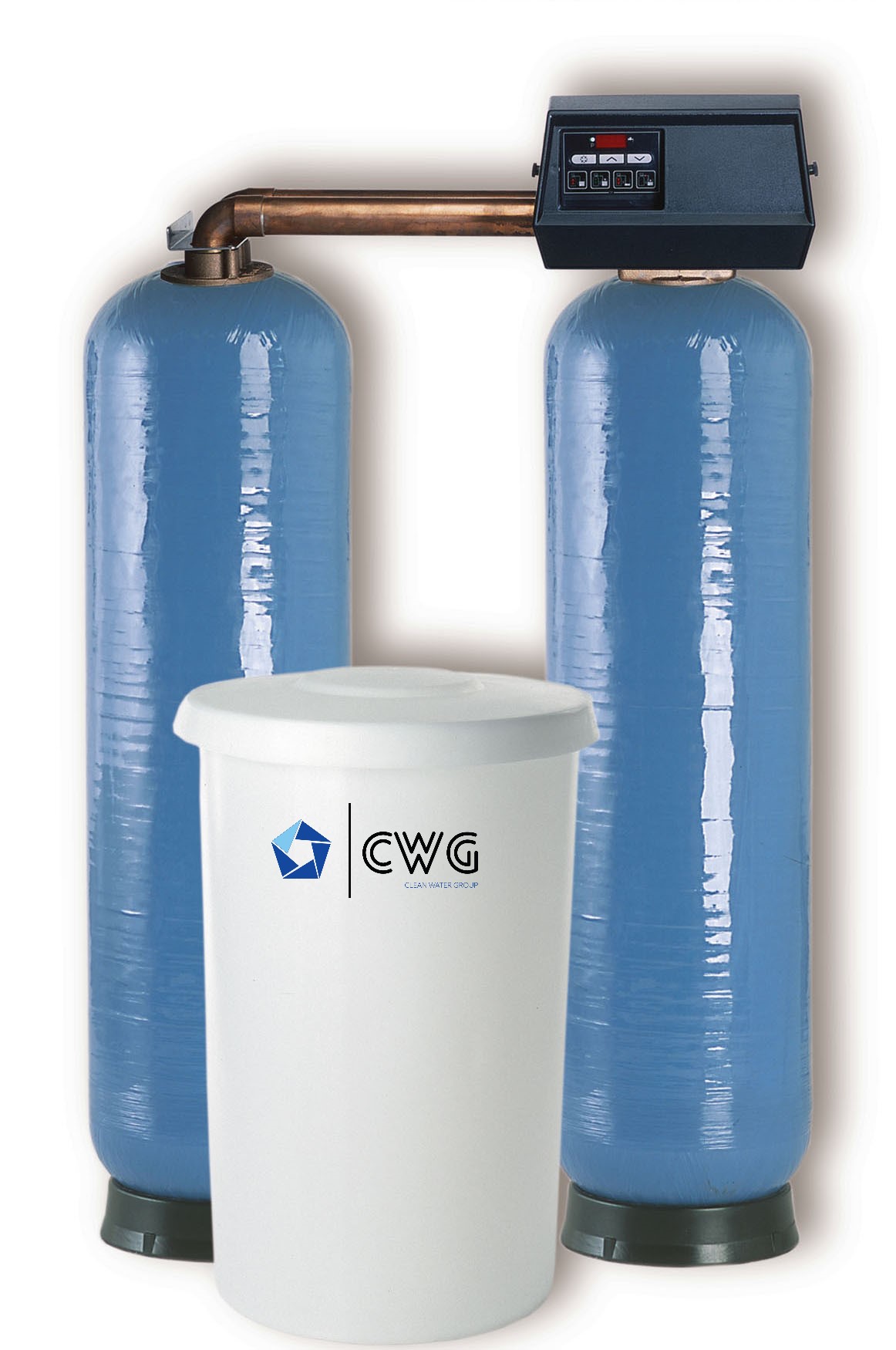
When we talk about water softening products, the most common are commercial water softeners consisting of water softeners and salt tanks. These systems are customizable and can be scaled according to household or industrial applications needs.

For more information or a direct offer, please contact us:
Contact form
Or by email: [email protected]

Hard water and limescale: why it occurs, what destroys you, and how to get rid of it permanently

White deposits on faucets and shower walls, cloudy marks on glasses you’ve just washed, a kettle that’s become stone-like after a few months, soap that barely lathers, and skin that feels tight after a shower — if all of these sound familiar, the water in your home is almost certainly hard. The good news: hard water is not dangerous to your health. The bad news: it’s the most expensive “silent” problem in the household, slowly and imperceptibly consuming your appliances, energy, detergents, time, and nerves. In this guide, we explain where hardness comes from, how to recognize it for sure, how much it really costs you, and which solutions really work — and which just sound good.

What exactly is hard water?

Water hardness is a measure of the amount of dissolved calcium (Ca²⁺) and magnesium (Mg²⁺) . Water is an excellent solvent in nature: as it travels through soil and rocks, it dissolves the minerals it encounters. When it passes through limestone, dolomite and similar carbonate layers — of which there are many in Europe — it becomes enriched with calcium and magnesium. The more of these, the “harder” the water.

As long as the water is cold and moving, these minerals remain dissolved. The problem begins when you heat the water or let it evaporate : then the calcium and magnesium bind together into a solid, hard deposit — scale (mainly calcium carbonate, CaCO₃) . This is why scale attacks first and most strongly where the water is hot: in the boiler, on the heating element of the washing machine, in the coffee maker and the kettle.

It is useful to distinguish between two types of hardness:

  • Temporary (carbonate) hardness — caused by bicarbonates of calcium and magnesium. It precipitates when water is heated and is the main culprit for limescale on heating elements.
  • Permanent (non-carbonate) hardness — from other salts that do not precipitate as easily upon heating and require a different treatment approach.

Why is hard water so common across Europe?

Much of Europe lies on karst, limestone and dolomite terrains — from the Mediterranean, through Central Europe, to parts of the continent’s west and east. Water that filters through such geology is logically rich in calcium and magnesium. This is why in many European regions, medium to very hard water is the rule, not the exception. Hardness is usually expressed in German degrees (°dH) or in milligrams of CaCO₃ per liter:

Category °dH mg/L CaCO₃
Soft water <8.4 <150
Medium hard 8.4 – 14 150 – 250
Hard 14 – 21 250 – 375
Very hard >21 >375

How to safely identify hard water

Hard water rarely comes on its own — usually several of these signs appear at the same time:

  • White, milky deposits on faucets, shower heads, tiles, and shower glass that keep coming back no matter how much you wipe them off.
  • Rapid scaling of kettles, coffee makers and water heaters; visible hard, white layer on the heater.
  • Soap and shampoo that don’t lather properly — you use more detergent, and your dishes and shower remain cloudy.
  • Grayish stains and stiff, rough laundry after washing, even with fabric softener.
  • Dry, tight skin and matte, hard-to-comb hair after showering, because mineral and soap residue is difficult to rinse off.
  • Drop stains (limescale) on glasses and dishes after drying.

Is hard water harmful to health?

No. Calcium and magnesium from water are part of the normal mineral intake and are beneficial to the body; hard water has no legal health limit as it does not pose a health risk. The only thing to pay attention to is the skin : in people with sensitive, dry or atopic skin, hard water can worsen dryness and irritation, precisely because soap and minerals are more difficult to rinse off and leave a film on the skin. This is a matter of comfort and care, not disease.

How much does hard water really cost you?

This is where hard water becomes very tangible — in monetary terms:

  • Energy for heating. Limescale is an excellent heat insulator. Even a thin layer of about 3 mm on a heater can increase the energy consumption for heating water by about a quarter to a third — the heater has to work longer and harder to reach the same temperature. This quietly increases your electricity or gas bill every month.
  • Device lifespan. Washing machines and dishwashers, instantaneous water heaters, boilers and coffee makers break down sooner, require more frequent descaling and more expensive services. A calcified heater is one of the most common causes of appliance failure.
  • Installations. Deposits narrow pipes and valves, reduce flow and pressure, and in extreme cases permanently damage plumbing parts.
  • Consumables. Constantly buying descaling agents, vinegar, citric acid, aggressive detergents and anti-limescale agents — an expense that never stops.

In other words, “doing nothing” isn’t free — it’s just a cost spread over many small, invisible amounts.

Limit values ​​(EU)

Hardness is not a mandatory parameter in the EU Drinking Water Directive (2020/2184) or in the national regulations of the Member States implementing it — simply because it is not a health risk, so there is no prescribed upper limit. From experience, a comfortable range for households is around 6–8 °dH : soft enough for limescale to disappear and soap to foam normally, while the water still has a pleasant, “full” taste. The goal of a quality softener is not zero-hardness water, but a smartly dosed, pleasant result.

When it comes to the impact of water softening on water purity, it is important to note that the ionic exchange process does not remove all types of contaminants from the water. Ionic exchange focuses on removing calcium and magnesium that cause water hardness. If water is the source of other contaminants such as bacteria, chlorine, heavy metals or organic compounds, additional treatment of water with other filtration or disinfection methods may be required to ensure complete purity.

Water softening has advantages:

  1. Prevention of sediments and deposits: Water hardness can cause precipitates and deposits of calcium and magnesium carbonate on faucets, water heaters, coffee machines and other devices. These deposits reduce the efficiency of the device and increase power consumption.
  2. Extending the life of the device: Regular softening of water reduces deposits on devices and extends their service life.
  3. Better efficiency of detergents: Stubborn deposits in water can reduce the effectiveness of detergents and soaps. Softening water allows better rinsing and foaming detergents.
  4. Better taste and smell of water: Softened water has less mineral content, which can result in better taste and smell.
  5. Reducing maintenance costs: Less depositmeans less cleaning and maintenance of the device.

With proper water softening, you can enjoy clean and soft water that will relieve you of unwanted deposits, improve the efficiency of household appliances and make everyday tasks easier.

Whether you are a household or an industrial institution, water softening provides a wide range of benefits for quality of life and process efficiency.

For more information or a direct offer, please contact us:
Contact form
Or by email: [email protected]